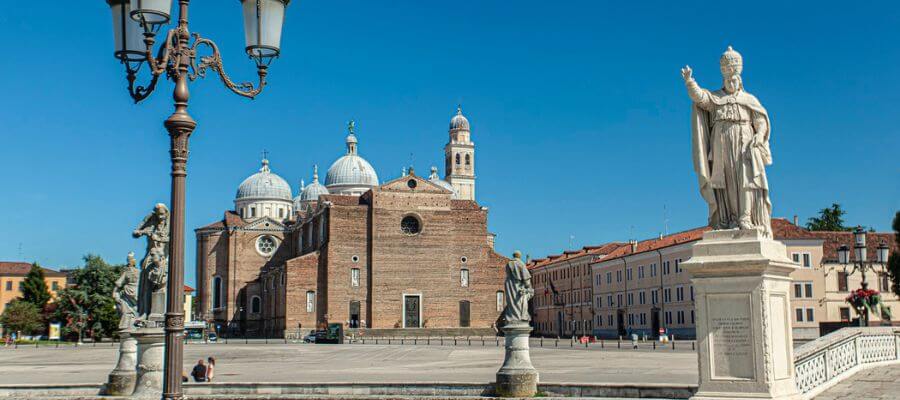
Padua is much more than Venice's cultured neighbor. If you're planning your vacation in Veneto, you can't miss the opportunity to immerse yourself in this world and discover a surprising city. Padua is a universe unto itself, needing no other highlights to shine.
Despite being very close to Venice, which you can reach by train in just 20 minutes, Padua is a city rich in harmonious contrasts between modernity and classicism, where the sacredness of the basilicas coexists with the jovial irreverence of the university, here where Galileo's revolutionary science walked on the same cobblestones trodden by pilgrims from all over the world.
From Saint Anthony of Padua to Europe's oldest Botanical Garden, from its splendid piazzas to its super-cool youth clubs, to Giotto's rooms and co-working spaces, visiting Padua isn't about checking off a list of things to see, but about finding a different rhythm. It means losing yourself among the thousand-year-old porticoes, sheltered from the sun or rain, and discovering art not only in museums but on the city walls and in its architecture. It also means understanding that aperitivo in the piazza here is something to be taken seriously.
This guide is designed to take you beyond the surface, directly into the beating heart of the city of the Saint and to discover Padua, even, spending little.
The heart of Padua: the experience of Padua Urbs Picta
If Venice is water and reflections, Padua is color and lines—and not just any color, but that of the 14th-century frescoes that earned UNESCO recognition as a "Urbs Picta." The obligatory starting point is, of course,the Scrovegni Chapel. Entering here means immersing yourself in the most famous ultramarine blue in the history of art, beneath a starry sky painted by Giotto, who forever changed Western painting.
The fresco cycle, created between 1303 and 1305, narrates the story of Salvation through two paths that culminate in the majestic Last Judgement on the counterfaçade. Giotto's revolution here was crucial to the future of art and anticipated Renaissance theories of perspective and the third dimension. The vaulted ceiling features a blue blanket of stars that extends the gaze to the heavens.
The fresco cycle doesn't end here but extends to the Baptistery of the Cathedral, where Giusto de' Menabuoi created a Paradise that completely envelops you, and into the majestic Sala della Ragione. For a complete tour and to discover 14th-century art, you can purchase the Urbs Picta Card, a single-price pass that grants you entry to all of Padua's main historical and artistic attractions without waiting in line or buying individual tickets.
You'll see the Scrovegni Chapel, including the Eremitani Museum and Palazzo Zuckermann, the Palazzo della Ragione, as well as the Oratory of San Michele, the Church of SS. Filippo e Giacomo agli Eremitani, the Oratory of San Giorgio along with the Basilica del Santo, the Chapel of the Reggia Carrarese, and of course the Cathedral Baptistery.
The city of mysteries and faith
Padua is a city capable of captivating all its visitors with its elegance and the history that exudes from every stone. Visiting Padua means discovering the very heart of the Veneto region, with its squares, monuments, and ancient architectural treasures. The city of Padua is nicknamed the "city of the three withouts," a nickname that encompasses both historical curiosities and legends.
1) The Nameless Saint: For the people of Padua, Saint Anthony is simply the Saint. His Basilica is an architectural masterpiece blending Byzantine and Romanesque styles, a place where spirituality is tangible.
2) The Grassless Meadow: Prato della Valle is not only one of the largest squares in Europe, but also the vibrant heart of the city. This area was once marshy and therefore grassless, although today there is plenty of grass. Today, it is an elliptical island surrounded by a canal and 78 statues of illustrious figures. It is the city's open-air living room.
3) The Café Without Doors: Caffè Pedrocchi, a historic meeting place for intellectuals and patriots, was once open day and night. Today, the doors remain, but the hospitality remains intact. Don't leave without trying the "Pedrocchino," mint coffee served in a large cup with a dusting of cocoa.
Padua, however, holds many other mysteries and interesting anecdotes that a true visitor should know, first and foremost the columnless capital in Piazza delle Erbe. Legend has it that the column was stolen, but in truth, it was deliberately removed to allow carts carrying goods to access the portico.
A practical solution that today is an enigma to be solved and a curiosity to be discovered, together with the curiosity regarding theastronomical clock of Padua and the lack of the Libra sign, perhaps out of spite for the client, even if in reality at the time of the construction of the clock the Libra sign was not yet known.
Legends and stories are many and extend throughout the city like an echo of history and adventure that only an attentive traveler can capture.
Padua, City of Knowledge: Galileo, the Garden, and Science
Padua is the city where thought was liberated. At Palazzo del Bo, the historic seat of the University, you can still see the wooden chair from which Galileo Galilei taught his students, and the world's oldest Anatomical Theatre, where modern medicine took its first steps. Palazzo Bo is a working museum, which has grown in fame over the years, with evocative courtyards and fascinating rooms to visit. Here you can explore true university life, where knowledge has been refined by generation after generation of scholars.
Not far away, science meets nature in theBotanical Garden, the oldest in the world still in its original location and a UNESCO World Heritage site. Don't think of it as a simple park: it's a living archive of biodiversity , where you can wander through greenhouses and gardens filled with rare trees and species. Strolling through its greenhouses, especially in spring, is a way to recharge your batteries away from the city traffic, but it's also a must-see for learning about and celebrating biodiversity.
If you want to deepen your understanding of the great Galileo Galilei, you can always visit his home: born in Pisa, Galileo spent some of his most significant years in Padua, between 1592 and 1610. Galileo was a scientist but also a citizen who loved the city of Padua, which for him was a stimulating environment, where he could think freely. You can access his home with a guided tour and wander within the same walls he walked through years ago, breathing in the same vibrant atmosphere.
The Ritual of Taste: The Aperitivo Culture in Padua
If you thought we'd finished talking about culture, you were wrong: here in Padua, even the aperitivo is a cultural event and should be done properly. When the sun begins to set, the sacred hour of the aperitivo begins. It's not just a drink, it's a social ritual.
Whether in Piazza dei Signori, under the elegant Clock Tower, or in any bar, order your spritz accompanied by some typical local appetizers while you watch the comings and goings of students, professionals, and tourists preparing for an aperitivo and feeling part of the city itself.
Padua is lived (and savored) in its squares. The beating heart of city life is the Palazzo della Ragione, which separates Piazza delle Erbe from Piazza della Frutta. But the real magic happens on the ground floor, in that maze of historic shops Paduans call Sotto il Salone. It's Europe's oldest natural shopping center: here, the aromas of aged cheeses, Venetian cured meats, and creamed cod tell stories of authentic gastronomic tradition.
Secret Padua: Off-the-beaten-track itineraries
If you've already seen the classics, consider that Padua still has much to reveal. For example, keep your eyes peeled for the alleys of the city center. Here in Cittadella, the city's historic center, you might stumble upon the unmistakable black silhouettes of Kenny Random, a local artist often called Padua's Banksy, or the dreamlike works of Tony Gallo that color entire neighborhoods.
Street art and mural art are the most innovative way to really get to know a city because they are free, open-air works of art that communicate directly with the people, giving voice to new and alternative problems or expressions.
If you want to be captivated by history, explore theancient Jewish Ghetto , with its narrow streets and tall buildings. This is undoubtedly the most evocative corner of the historic center. Among small artisan workshops, quiet wine bars, and the intimate atmosphere, it will seem like another city, ideal for a thoughtful stroll.
Finally, if you want to say you've seen everything in Padua, then you must reach the Observatory. Reach the Torlonga of the Carrarese Castle, a powerful family of feudal lords who ruled Padua between 1318 and 1405, today home to the ancient astronomical observatory. The view of the tower reflecting on the waters of the Bacchiglione, perhaps at sunset, is one of the most romantic and unexpected postcards of the city. Staying in this corner of the city is like having a balcony overlooking the world: here you can feel the breath and movement of everything and have the luxury of taking your time to admire the most evocative panorama of the city.
These alternative spots in Padua give you the opportunity to take interesting photos and take home a unique, personal memory of this splendid city.
Beyond the Walls: Treasures Around Padua
Padua isn't just a destination, it's a starting point. Its strategic location makes it the perfect base camp for exploring the authentic Veneto, made up of volcanic hills, medieval villages, and noble villas, all reachable in less than half an hour.
If you've chosen to stay here for a few days, here's how to enrich your trip with experiences that will make you fall in love with this land.
The Euganean Hills: Nature, Wine, and Poetry
Just outside the city, the horizon unfolds. These are the Euganean Hills, an archipelago of volcanic hills rising from the plain like green islands. Don't expect rugged mountains, but gentle slopes covered with vineyards and forests, perfect for reconnecting with nature.
Nestled among these hills lies Arquà Petrarca, one of the most beautiful villages in Italy. Here, time has stood still since the 14th century, when the great poet Francesco Petrarca chose to spend his final years. A stroll through its narrow stone streets, perhaps while enjoying a glass of brodo di giuggiole (the local liqueur), is a must. If you love classical beauty, don't miss the Valsanzibio Garden. With its maze of centuries-old box trees and symbolic fountains, it's a breathtaking path to spiritual salvation.
Walled cities: a dive into the Middle Ages
The Padua area is dotted with fortified cities and villages that tell stories of battles and nobility.
Head to Cittadella , the city of walls, for a day trip. Imagine walking along the walls of a medieval city, completing the entire circuit at 15 meters above the ground. This is possible in Cittadella, and it's a unique experience in Europe. Further south, discover Montagnana , which welcomes you with its perfectly intact city walls and is famous for the Palio dei 10 Comuni (Palio of the Ten Municipalities).
Or Monselice, with its evocative walk of the Seven Churches that climbs up to the majestic Rocca di Monselice, perhaps one of the most charming villages to visit in the area of Padua. Don't miss the village of Este, another quiet town nestled in the Euganean Hills, with its Carrarese Castle and public gardens.
If Venice is the queen, the Brenta Riviera was her garden. Along this canal, Venetian nobles built their summer residences. Today, you can relive that splendor by visiting Villa Pisani, the Versailles of the Veneto, or by boarding the Burchiello, the boat that connects Padua to Venice on a slow cruise through art and nature.
Euganean Spas: A wellness getaway even in winter
Abano and Montegrotto are a smart choice when the weather isn't cooperating or when you want to combine culture and relaxation. Whether it's spring, summer, autumn, or winter, you can find your relaxing break in Veneto, experience the spas and ozone therapies, hike through the Euganean Hills, visit villas, and, above all, savor risottos and local specialties.
Tips for experiencing Padua like a true local
Don't try to do everything in one day. That's the beauty of having an apartment as your base: you can spend a morning at the Padua market, an afternoon relaxing in the hills, and in the evening return home for a glass of wine on the terrace. Padua isn't a hit-and-run city, as we've seen; it's a city to experience, and it's been voted one of the best cities in the world for digital nomads and smart working.
If you're still looking for the perfect accommodation for your exploration, check out our centrally located options and get inspired by our exclusive offers for an unforgettable stay.

