Experiencing the city of Padua means immersing yourself in a fascinating world of secrets and mysteries that make it a unique and captivating place. To those who wish to discover it, the city reveals a thousand faces, intertwining history, legends, and architecture in a fascinating mosaic of mysteries. For example, Saint Anthony of Padua , universally known as "The Saint," has a linguistic anomaly: his name is often implicit, so much so that the Basilica erected in his honor is simply called "Basilica of the Saint." So much so that Padua is often described as a city of a nameless saint . Every corner of the city seems to hold a secret, transforming its exploration into a continuous adventure between past and present: let's discover some of the iconic sites worth visiting.
The column-less capital in Piazza delle Erbe and the riderless horse at Palazzo della Ragione
Walking through Piazza delle Erbe , you might notice a peculiar capital seemingly devoid of a column . Legend has it that it was stolen during the night by the people of Vicenza; however, the truth is equally fascinating. It would seem that the column's absence was deliberate to allow access to the portico by carts carrying goods. A practical solution that turns into a visual enigma.
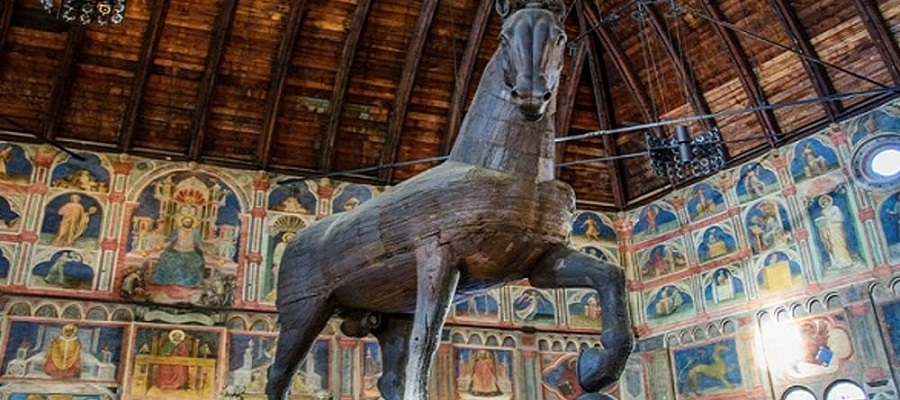
Continuing this exploration, we can discover how, inside the Palazzo della Ragione, a large riderless wooden horse captures the attention of visitors and is modeled on the monument to Gattamelatta in Piazza del Santo.
Pedrocchi Café and Padua Station
Caffè Pedrocchi , an icon of Padua, has a special anecdote tied to its doors. It is said that this place was open day and night until 1916 , when it began closing in the evenings during the First World War to avoid attracting the attention of the Austrians during the bombing raids. A timeless atmosphere that unfolds through the history of one of the city's most beloved places.
Finally, although it may seem strange, Padua station also hides a mystery, a subtlety that escapes the inexperienced eye: the lack of a platform for track 4. The tracks are present, but it seems that this track is reserved exclusively for the passage of freight trains.
The astronomical clock of Padua and the symbol of the University
Looking up under the Clock Tower in Piazza dei Signori, you'll notice the absence of the zodiac sign of Libra . Legend suggests the builder was taking revenge on his client, but the truth lies in the fact that, at the time of construction, Libra was not yet recognized as an independent constellation in Greek astronomy.
The Palazzo del Bo , symbol of the University of Padua, features an intriguing emblem: a bucranium, the skull of a hornless ox. This symbol is thought to derive from the ancient Hospitium Bovis inn , located on the same site as the Palazzo del Bo. This curious symbol represents a connection to the city's commercial history.
The cathedral without a façade: the cathedral basilica of Santa Maria Assunta
The Basilica Cathedral of Santa Maria Assunta, commonly known as the Padua Cathedral, reveals a fascinating architectural detail: its unfinished façade . Despite the structure's construction in the 16th and 18th centuries, the grandiose façade designed by Girolamo Frigimelica was damaged during the bombings of World War I, adding a touch of mystery to the city's architecture.
The bell tower without a church
A bell tower without a church, visible at the intersection of Via San Fermo and Via Giovanni Cittadella , highlights a lost chapter in Padua's history. The presence of a church destroyed over time suggests an ancient and mysterious narrative that dissolves into the modern urban fabric.
Staying in Padua is essential to fully immerse yourself in the city's mysteries and appreciate its monuments in a different light. The nightlife offers unique atmospheres, making your stay a complete experience. To optimize your accommodation choice, booking an apartment online is the smartest way to plan a stress-free trip.
.

