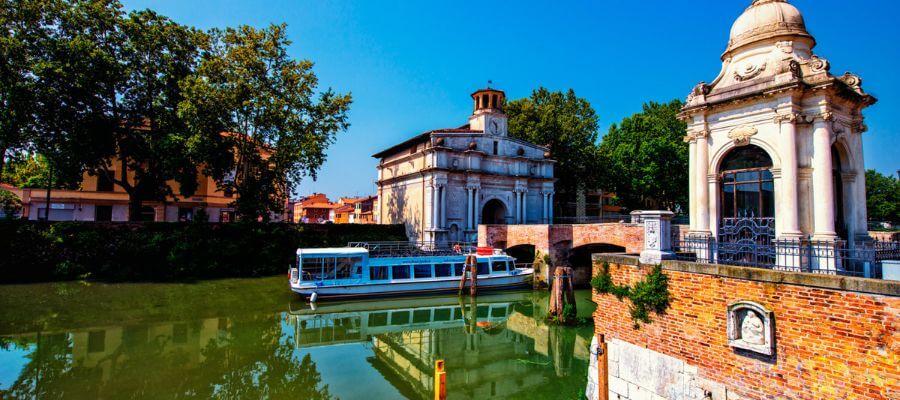
It's true, as they say, that the soul of a city lies in its water. In Padua, for example, the same magic is replicated as in Venice, where water is the undisputed protagonist and emanates a captivating power over the city.
Padua, although not primarily known for its river and canals, has characteristics that can compare it to its more famous Venetian sister, and perhaps even surpass it in uniqueness and historical charm.
Padua was once crisscrossed by an intricate network of canals and navigli, waterways created specifically to connect the canals and along which goods and people were transported. It takes a stretch of the imagination, but Padua in the past was substantially different from how it appears today.
This is why it's important to take a journey with your mind. Staying in Padua allows you to relive the city's history through its river and discover many alternative ways to experience the city .
Padua, city of water
According to legend, Padua was founded by Antenor on a double bend of the Medoacus (now the Brenta). Once upon a time in the Veneto region, rich in natural waterways, the city was a labyrinth of waters, bustling with gondolas, boats, and barges for the transport of goods and people, much like modern Venice.
Within the medieval walls flowed the famous Naviglio Interno , a canal that, starting from the Carrarese Castle and the Specola Tower, forked into two branches before rejoining at the Porte Contarine Navigation Basin. From here branched off the Naviglio del Piovego , a canal dug around 1200 and approximately 8 km long, which connected Padua to the Brenta Riviera and all the way to Venice.
At Portello, instead, stood the ancient river port, embellished during the Venetian domination by a very scenic staircase, the Burchiello . The river traffic coming from the Lower Padua area, Vicenza and the Euganean Hills, crossed the city and passed along the winding rivers until it entered the Conca delle Porte Contarine and reached the lagoon. Along the Naviglio Interno, nobles and patricians traveled by gondola to their estates.
In 1800, with the aim of protecting the city from flooding, new canals and the Voltabarozzo Basin were built. This created a river loop of approximately 7 km, which in the 1950s was known as the Naviglio Interno.
In May 1960, tourism director Francesco Zambon proposed reviving the traditional burchielli service , which from 1200 until the fall of the Serenissima connected Padua to Venice. The project was a resounding success, and even today, shipping companies transport over 50,000 tourists a year. The routes run from Porte Contarine to Portello, towards the Brenta Riviera and Venice, or towards Bassanello to Selvazzano or Castello Carrarese.
Waterways were once preferred to roads, so it was common to board burchielli (a type of barge) and navigate the Naviglio Interno (Naviglio Interno), encountering the boats, barges, and gondolas that brought the city to life. Unfortunately, this is no longer possible today, but it is possible to explore some of the more or less touristy waterways to see Padua from a fascinating new perspective .
Exploring Padua by water
The dense network of waterways allows for seven different river itineraries, suitable for both those seeking a tourist experience and those wanting to explore lesser-known routes. The navigable canals are:
- The Brenta;
- The Piovego;
- The Bacchiglione;
- The Battle;
- The Bisato;
- The Pontelongo;
- the Brentella.
Among these, the most beautiful are the cruise through the streets of the historic center, the excursion along the Battaglia Canal that passes by the castles and historic villas of the Euganean Riviera, and finally the navigation along the Riviera del Brenta that leads to the Venetian lagoon and offers postcard-perfect views.
Where to board
Thanks to its extensive network of canals, Padua offers several embarkation and docking points, ideal for starting or stopping off for exploration. Among the main ones:
- Porte Contarine in Via delle Porte Contarine
- Porta Portello along the Piovego
- Bassanello near the Scaricatore Bridge
- Tencarola in Selvazzano along Provincial Road 13
- Pier of the church of Vigodarzere
- Villa Giovanelli in Noventa Padovana
The choice is entirely up to the traveler: boat or ferry? Alone, as a couple, or with a group of friends? Whatever your decision, you won't have to worry about a thing: the captain will guide you along the way.
Boat tour among the wonders of Padua's city center
Discovering Padua from the perspective of its canals is a unique experience. Cruising along the city center's waterways, you'll find yourself immersed in a city that reveals hidden corners among bastions, historic bridges, and palaces overlooking the banks.
Among the most evocative stops, the Porte Contarine , an ancient hydraulic system that powered the city's first electrical systems in the 20th century. A little further on, you come across the magnificent Porta Portello , with its columns, stone lions, and spectacular 16th-century staircase. The latter has been restored and was immortalized in the works of Canaletto and even cited by Goldoni, who called it " a most beautiful canal of mirrors and carvings ."
Aboard traditional wooden burci, carefully restored and sometimes converted to electric versions, you can experience the authentic spirit of Padua's riverside life. These historic vessels, including burchielli and padovanelle, are truly unique, preserved intact in their original form.
Sailing the Brenta with arrival in Venice
One of the most iconic routes follows the Brenta River from Padua to the lagoon. It's a perfect itinerary for both short half-day trips and longer excursions, enriched with cultural stops.
As you sail, you can admire numerous Venetian villas, testaments to Venetian opulence. The noble families of the Serenissima loved to spend their summers here, between lavish parties and relaxing days, building spectacular homes along the waterway. Today, these residences still elegantly overlook the river, ready to welcome visitors with art, architecture, and history.
Discovering the Euganean Riviera
A fascinating, but lesser-known, alternative is the route that crosses the Euganean Riviera. From Padua, you can follow the canal to Battaglia Terme and then continue towards Monselice , amidst the green landscapes, stately villas, and castles that dot the Euganean Hills .
This stretch, once beloved by Venetian patricians, is ideal for a full-day excursion, with stops at the most interesting landing points. On the return journey, you can choose to return by boat or combine the excursion with a bike ride for a slow, scenic experience.
Padua: you haven't seen everything yet
If you thought you'd seen enough of Padua, you're sadly mistaken. Padua is a city with so much to offer, and many hidden gems are hidden among its streets, which have changed over the years and are constantly being updated to adapt to modern life and the needs of its residents. If you're planning a weekend in Padua and are looking for interesting and alternative activities, a boat excursion is the perfect option for you .
You can stay in one of our independent apartments and have complete freedom to move around and explore. Experience the thrill of sleeping in a house that once stood directly above a now-extinct canal and embark on an experience that will allow you to navigate the city and admire its beauty from a new perspective.

