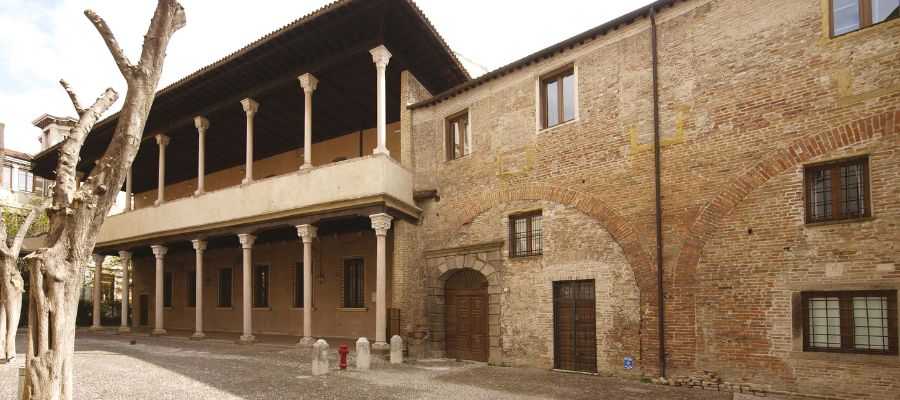
In Padua, you can experience an atmosphere steeped in history and unique architectural and artistic beauty. This is the case with the famous Reggia dei Carraresi, a Paduan marvel not to be missed if you decide to visit the city.
Built in 1338 by Ubertino da Carrara, the palace is a symbol of the Carraresi's power over the city of Padua. They also hosted Petrarch and many other famous artists in the sumptuous villa, which reached its peak splendor under the reign of Francesco the Elder, an enlightened patron of the arts. Today, it is possible to visit the palace and admire the 14th-century loggia and the sensational fresco cycle by Guariento.
Visiting this splendid complex allows you to truly step back in time, even though much of its former splendor has been lost over the centuries. The villa remains a luxurious residence, the political, cultural, and artistic center of the city of Padua and its lordship. The palace was much more than a stately home, and crossing its threshold today, one can still sense the political and cultural power these walls represented for the city.
If you're planning a trip to Padua, you can't miss the opportunity to visit this historic wonder. Whether for a weekend or a few days' vacation, opt for a smart solution with a short-term rental and access numerous apartments and options to make your stay in Padua even more iconic.
The building: a complete description of the Carraresi palace
Like many other historic buildings, the Carraresi palace has undergone many changes over time, and the complex, which once included palaces, towers, and gardens in the historic center of Padua, right next to the Cathedral, is now reduced to just a couple of buildings: the Palazzo Liviano with the Sala dei Giganti and the famous Loggia Carrarese, the current home of the Galilean Academy in Via dell'Accademia, and a sensational decorative apparatus.
The palace was in fact designed to host poets, writers, and thinkers, as well as artists from every corner of the world. A dynamic and vibrant cultural environment, where even Francesco Petrarca took refuge under the protection of the Carraresi. The same artists worked on the decorations of the palace, which at the time was architecturally and decoratively avant-garde.
The palace contains frescoes and much more: sculptures and works depicting religious themes of extraordinary historical importance. Unfortunately, following the Venetian conquest, many of the palace's structures were dismantled and converted, and only a small portion of the beauty that once captivated so many prominent figures has survived. Today, it is possible to visit the Cortile Maggiore and the Chapel of San Giorgio, on the first floor of the palace. Other remains of the palace are housed at the Galilean Academy of Sciences, Letters, and Arts.
The Hall of Giants
A highly significant fresco cycle is found in the so-called Hall of Giants, on the second floor of the palace. The room's name derives from the frescoes that decorated it, although in the 14th century it was known as the Hall of Heroes, at Petrarch's suggestion, because it depicted illustrious figures of the time.
The original hall was destroyed by fire and completely renovated in 1540 with a fresco cycle by Domenico Campagnola and the Paduan school. The hall was used for parties and meetings and later became the university library.
The Carrarese Loggia on Via dell'Accademia
Beyond Palazzo Liviano, on Via dell'Accademia, is the Loggia Carrarese, one of the remaining intact parts of the large complex, symbolizing the family's grandeur. The Accademia's double loggia and the adjacent rooms were the Princes' residence.
In 1800, a wing of the loggia of Palazzo Ubertino was demolished, and over the years the walls were converted into houses, and the private chapel was demolished to enlarge the meeting hall. The external loggia is enclosed and frescoed by Guariento with scenes from the Old Testament, some of which have been lost. The decoration of the Meeting Hall includes a plan created by the cartographer Giovanni Valle, the first to use trigonometric calculations to create plans.
The fresco cycle by Guariento
Guariento di Arpo was an accomplished painter who worked in Padua and Venice, and whose style drew on the Giotto tradition. The frescoes in the Loggia were created between 1346 and 1354 , and early Byzantine influences can be seen. Arranged across two sections, the scenes depict key episodes of the Old Testament, including Noah and his drunkenness; Abraham speaking with the three angels, perhaps the most iconic pictorial work in Guariento's style; and then the apocalyptic scenes of Sodom and the sacrifice of Isaac. The latter, in which pathos is taken to the extreme, are further emphasized.
The upper section features scenes from the life of Joseph, while the front register depicts episodes of Goliath's death and the judgment of Solomon. The scenes don't end there, as prophets and many other figures alternate, depicted at epic moments in their lives. Many of the frescoes have been lost, but this pictorial cycle remains one of the most important and unmissable of the 14th-century Paduan art scene, including the beautiful Judith Beheading Holofernes.
See the Carrese Palace in Padua
To discover Padua, its hidden streets and hidden beauties, as well as the Reggia Carrese, one day alone isn't enough! Our advice is to enjoy a long weekend , saving time and money by booking an apartment online.
With this solution, you can not only save money but also enjoy the beauty of the city without stress and problems.

