The city of Venice, with its glittering canals and its corners steeped in history, has always enchanted visitors from around the world. But beyond the most popular destinations, there exists a lesser-known Venice, made of hidden gardens, contemplative silences, and stories that intertwine the charm of the past with the beauty of the present to create a unique atmosphere.
So, if you're thinking of spending a short vacation in Venice and are ready to explore the city in an alternative way, this article offers an unusual itinerary, away from the crowds, designed specifically to help you experience a unique and unforgettable day in the Serenissima.
Discovering Venetian gardens
The unexpected Venice hides behind ancient walls and discreet gates. The lagoon city's gardens, often hidden from the eyes of passersby, are small havens of peace where history, nature, and architecture blend together.
The garden of the Old School of Mercy
The first garden you enter is one where you can pause to contemplate its beauty. Located in the Cannaregio district, it is accessed through a captivating Gothic-style cloister. The garden covers 2,300 square meters, and you can explore its perimeter via two walkways lined with a red rose hedge. Both are shaded by vines and wisteria, which, during the flowering season, make the experience even more magical and dreamy.
The species that can be admired include centuries-old cypresses, false jasmine, laurels and oleanders of many colors, but the most interesting species in this garden is the marmai rose, a special hybrid of flowers that reaches 15 cm in diameter.
The Gardens of the Church of San Francesco della Vigna
Overlooking the northern shore of the lagoon, the convent of San Francesco in Vigna is renowned in the area for its flourishing vineyards, while the church is renowned for its façade designed by Antonio Palladio. A place that invites reflection, thanks to its spiritual history and the charm of its vegetable gardens. Here, an air of simplicity evokes the essence of monasticism and respect for nature.
Today, the gardens are divided into several sections, including a vineyard where Teroldego del Trentino and Refosco del Friuli vines are grown.
Strolling through the gardens, you can admire fruit trees, aromatic plants, and flowers that, together, create a serene and contemplative atmosphere. These green spaces not only reflect the monks' self-sufficiency, but also demonstrate a deep connection with nature and a dedication to cultivation as a spiritual practice. It is an ideal place for those seeking a moment of tranquility and reflection, surrounded by history and natural beauty.
The garden of Ca' Morosini
In the 17th century, the Morosini family purchased a complex of buildings that still bears their name today, located in the Cannaregio district. The current complex and garden were built at the behest of their descendants and are a typical Venetian garden, rich in ornamental plants interspersed with a vegetable garden and fruit trees.
Crossed by two pergolas of roses and Virginia creeper, it features a varied and rich vegetation of irises, petunias, mimosas, dahlias, snapdragons, along with apricot trees, figs, persimmons, pomegranates and finally olive trees and cypresses.
The garden of the Casino degli Spiriti
Also in the Cannaregio district is this place shrouded in mystery and charm. Part of the Palazzo Contarini dal Zaffo complex, this secret garden overlooks the lagoon, offering a picturesque view and a tranquil atmosphere far from the beaten tourist track. The evocative name Casino degli Spiriti (House of the Spirits) comes from the legends surrounding this place, once considered a gathering place for artists, philosophers, and intellectuals, but also strangely associated with enigmatic presences and ghost stories.
These tales have contributed to creating an aura of mystery around the garden and the adjacent building. The garden itself is an example of Renaissance elegance, rich in architectural and botanical elements reflecting the era in which it was created. Strolling along its paths, you can encounter centuries-old plants and details that bear witness to the Venetian history and culture of the time. Visiting the Casino degli Spiriti garden means immersing yourself in a timeless atmosphere where natural beauty blends with the charm of Venetian legends.
A dive into the history of Venice with Casanova
One cannot talk about an alternative visit to Venice without including places that intertwine human stories and memories of the past.
The Wheel of the Innocents of the Monastery of Piety
The Wheel of the Innocents at the Monastero della Pietà in Venice represents a significant historical testimony to the care of abandoned newborns. Located on Calle della Pietà, near the Riva degli Schiavoni, this structure was part of the orphanage attached to the monastery. The wheel was essentially a cylindrical wooden mechanism rotating around an axle that allowed mothers to abandon their unwanted newborns in complete anonymity. By placing the child in the wheel and turning it, the newborn was welcomed into the institution without the mother's identity being revealed.
This system guaranteed discretion and safety and offered the children a better chance at life. Today, the Wheel of the Lambs is still visible, integrated into the Hotel Metropole, which occupies the former monastery. Although no longer in use, this site remains a symbol of Venetian history and the city's commitment to assisting the most vulnerable, and is well worth seeing.
The Bridge of Sighs with Casanova's prisons
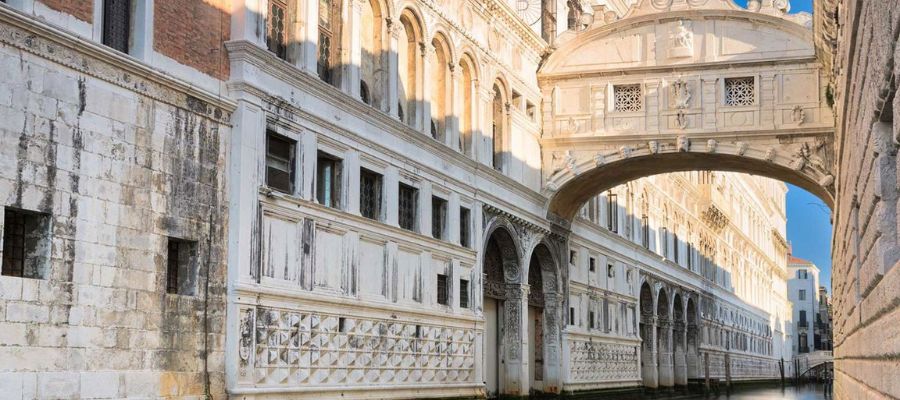
Built in 1614, the Bridge of Sighs isn't exactly a little-known area of Venice, but one of its most iconic. What's often overlooked are the legends surrounding the Bridge and the New Prisons, to which it connects the Doge's Palace. It's a covered bridge used to transport prisoners from the Palace to the Prisons, and then from the courthouse to their cells. The romantic name "Bridge of Sighs" derives from the fact that, perhaps, the prisoners, crossing it, sighed as they gazed out through the small windows at the lagoon and their lost freedom for the last time.
Among the most famous prisoners to have crossed this bridge was Giacomo Casanova, the renowned 18th-century adventurer and seducer. Arrested in 1755 on charges of "libertinism" and other charges, Casanova was incarcerated in the Piombi, the prisons located under the roof of the Doge's Palace. His daring escape in 1756, through a hole in the ceiling of his cell and then through the roof of the palace, has become legendary, lending even more intriguing depth to the history of the Bridge of Sighs and the Venetian prisons.
Visiting the Bridge of Sighs and the prisons offers a glimpse into the history of Venetian justice and the human events that have shaped these places, allowing you to relive atmospheres steeped in mystery and charm.
Venice: a city to discover with new eyes
This alternative Venice invites you to look beyond the surface, to lose yourself in its secret gardens, and to be captivated by the stories that emerge from its thousand-year-old stones. A city that, far from the crowds and mass tourism, reveals its most authentic essence and offers you an unforgettable day.
Get ready to experience a Venice you don't expect: a city of silence, beauty, and history just waiting to be discovered. Do so by booking an apartment online in advance.

