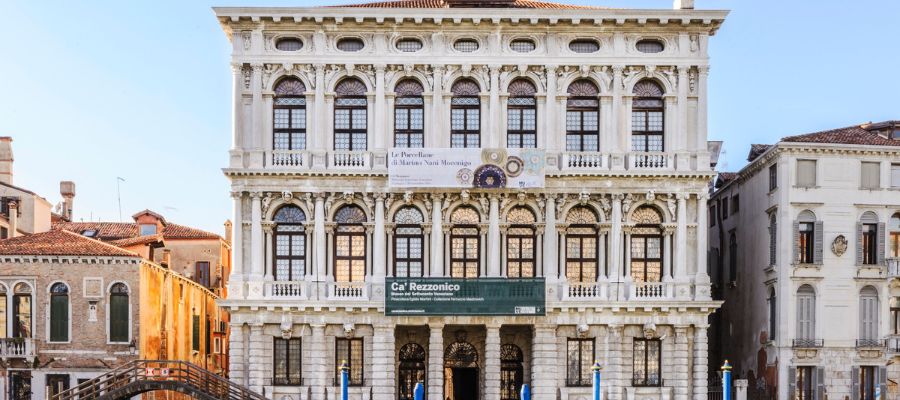
There are destinations that are truly journeys, and then there are places that transform a simple visit into a timeless experience. Ca' Rezzonico , a majestic palace overlooking the Grand Canal, is one of them.
Crossing its threshold is like stepping into the beating heart of 18th-century Venice , a journey through time, plunging into an era of pomp, refined art, and high society. This architectural masterpiece, conceived by the genius of Baldassarre Longhena and completed by Giorgio Massari, encloses within its splendid walls spectacular frescoes, exquisite furnishings, and an art collection that showcases the most fascinating side of the Serenissima.
But it's not just its beauty that makes it special: Ca' Rezzonico is a true journey into the Venice of yesteryear, the Venice of grand masquerades, gondolas gliding silently along the canals, and living rooms lit by flickering candles.
Today, transformed into the Museum of 18th-Century Venice , the palace continues to enchant visitors from around the world, offering an immersive experience of one of the most elegant and fascinating eras in history. Are you ready to discover its secrets?
The history of Ca' Rezzonico
The Museum of 18th-Century Venice is located in the Rezzonico palace, designed by Baldassarre Longhena and Giorgio Massari and commissioned in the 17th century by the noble Bon family, eager to assert their prestige in Venetian society.
The building, overlooking the Grand Canal, is an ambitious residence, entrusted to the architect of Santa Maria della Salute and Ca' Pesaro. Construction began around 1649, but due to financial difficulties and Longhena's death in 1682, the building remained unfinished for several decades, leaving a majestic structure unfinished waiting to be completed.
The Rezzonico family purchased the unfinished palace in 1750 to transform it into a prestigious residence. They entrusted the completion of the work to architect Giorgio Massari, who continued the construction, respecting Longhena's original design but introducing stylistic updates in keeping with the 18th-century style. The palace was completed in 1758 , coinciding with the election of Carlo Rezzonico as Pope Clement XIII.
From that time on, the sumptuous residence became known as Ca' Rezzonico, a symbol of the family's power and influence in 18th-century Venetian society. Today, its interior features unique period furnishings and ornaments , as well as important 18th-century Venetian paintings and frescoes by Tiepolo and Canaletto.
The museum has been enriched with works and donations from artists such as Tintoretto, Sebastiano and Rosalba Carriera, Francesco Guardi , and many others. The exhibition unfolds over four floors and a garden promenade.
The facade of Ca' Rezzonico
From the very first glance, we can recognize the façade of Ca' Rezzonico as a masterpiece of Venetian Baroque, majestically rising over the Grand Canal. The façade unfolds on three main levels, each with distinctive elements that enhance its grandeur.
On the ground floor , a large central arched portal opens, flanked by rectangular windows framed by Doric pilasters. This level is topped with smooth ashlar, lending solidity to the entire structure.
The first main floor features a movement punctuated by arched single-lancet windows adorned with balustrades and framed by Ionic semi-columns, and above each window there are alternating triangular and curvilinear tympanums to accentuate the dynamism.
second floor also continues the same pattern, with Corinthian columns and simpler, more linear cornices to maintain a balance between decorative richness and sobriety. The façade is completed with a protruding cornice that adds elegance to the overall effect.
Inside the Ca' Rezzonico palace
Inside the palace, the rooms reflect the luxury and refinement of eighteenth-century Venice ; in particular, the ballroom is one of the most monumental rooms in Venice, both in terms of size and the quality of the pictorial decorations.
On the ceiling we find Apollo in his chariot by Giambattista Crosato, a recurring theme in many homes of the period, while on the wall opposite the entrance you can admire the coat of arms of the Rezzonico family.
Ca' Rezzonico houses an extraordinary collection of works by the greatest masters of 18th-century Venetian painting . Among the artists represented are illustrious names such as Canaletto, Tiepolo, Longhi, and Guardi. Their works capture the essence of 18th-century Venice, from architectural views to moments of daily life, including allegorical scenes and portraits.
A prime example is Giambattista Tiepolo's " Mondo Novo ," a detached fresco depicting a group of people peering through an optical chamber in search of distant lands. Then there's Pietro Longhi's " Il Ridotto ," which depicts a scene inside a Venetian casino and illustrates the social customs of the time.
In addition to paintings, Ca' Rezzonico boasts a rich collection of sculptures and decorative arts that testify to the luxury and refinement of 18th-century Venice. Among these are the works of Giusto Le Court, with their dynamic expressions, found throughout the palace, adding movement and depth to the spaces. Not to mention the sumptuous original period furnishings, inlaid furniture, fine porcelain, and exquisite objets d'art crafted with masterful craftsmanship.
The Ca' Rezzonico palace is representative of 18th-century Venetian social life, a life steeped in pomp and centuries-old traditions. This museum illustrates the era's social stratification, with the aristocracy at the top, followed by the merchant bourgeoisie, and then artisans and workers.
Through the Ca' Rezzonico Museum, you can immerse yourself in this fascinating world, discovering the nuances of everyday life and the opulence that characterized 18th-century Venice.
Ca' Rezzonico: much more than a museum
Today, Ca' Rezzonico is not only a beautiful historic palace but also a veritable treasure trove, preserving Venice's cultural heritage during its heyday. Transformed into the Museum of 18th-Century Venice , the palace offers the opportunity to immerse yourself in the atmosphere of the era, its most refined and opulent. Each room tells a story of luxury, culture, and daily life.
Ca' Rezzonico is more than a museum : it's a bridge between past and present, a place where history isn't just displayed but can be felt and experienced in every detail. Visiting it, you truly understand why Venice is more than just a city, but a timeless experience to be savoured.
And to truly experience timeless Venice, nothing compares to staying in a home that makes you feel part of the city.
Choosing a short-term apartment rental instead of a hotel allows you to experience the Serenissima with greater freedom, without time constraints and with the privilege of waking up every morning to the call of the water and the buzz of the markets.
Venice isn't just a destination to visit, but a place to live, at least for a few days, to be captivated by its unique and unrepeatable rhythm.

