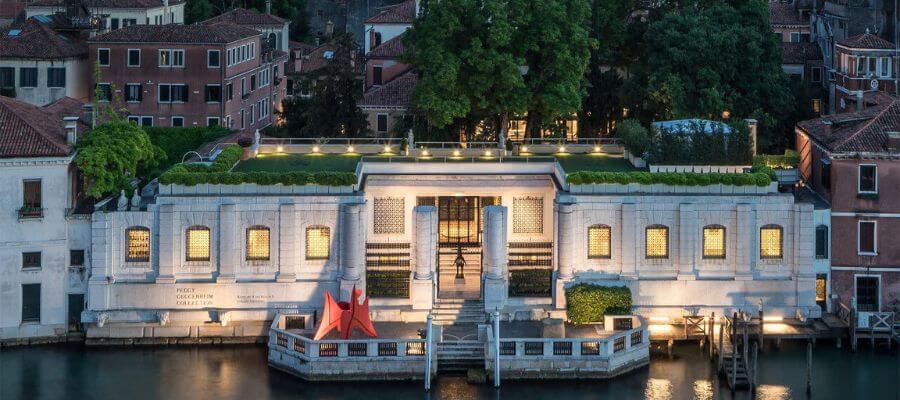
Venice is the cradle of international art. Beyond its bridges, narrow streets, churches, and squares, the palaces of the Grand Canal house one of Europe's most important collections of modern and contemporary art, housed in a building that is itself an architectural enigma. The Peggy Guggenheim Collection is the most visited museum in Venice after the Doge's Palace and the largest in Italy for modern and contemporary art.
If you're planning a Venetian weekend or a vacation in the Veneto region and you love 20th-century art and history, this is a must-see: here, you can immerse yourself in the emotions of reliving key moments of the 20th century through extraordinary works and stories of illustrious artists, along with the story of a woman who revolutionized contemporary collecting.
Palazzo Venier dei Leoni: the unfinished palace
The Guggenheim Collection is housed in the fascinating Palazzo Venier dei Leoni, an eighteenth-century building overlooking the Grand Canal that immediately strikes you with its particular feature: although it was designed to be five stories high, it has only one.
Commissioned by the noble Venier family in 1749 from architect Lorenzo Boschetti (the same architect who designed the church of San Barnaba), the palace was intended to embody the influence of Palladio and Longhena with a monumental classical façade with triple arches, a counterpoint to Palazzo Corner on the opposite side of the canal. However, historical events involving both the family and the city halted construction after just a year, leaving only the ground floor completed.
Today it is one of the most iconic and recognizable places in Venice, precisely because of its unique unfinished appearance. Known as the Palace of the Lions because it is said that a lion was once kept in the garden, but in reality the reference is to the Istrian stone lion heads that decorate the façade right at the water's edge.
Peggy Guggenheim's Venetian Dream
“I am not a collector, I am a museum.” This is how Marguerite, known as Peggy Guggenheim (1898–1979), defined herself. She was much more than a wealthy American heiress. Ex-wife of the surrealist artist Max Ernst, grandson of the magnate Solomon R. Guggenheim, Peggy was a patron, a visionary collector, and a key figure in the twentieth-century art scene.
After years in New York and Europe supporting and promoting emerging artists, Peggy purchased Palazzo dei Leoni in 1948 with the intention of moving to Venice. It was here that she brought her entire personal art collection, an extraordinary testimony to the past, the struggles, the ideas, and the freedom of those years, a collection rich in authentic passion.
Contemporary sculpture exhibitions are held in the garden, while at the Museo Correr, Peggy curated Jackson Pollock's first European solo exhibition, launching American abstract expressionism onto the international scene. Peggy died in 1979 at Palazzo Venier, the same place where she had lived surrounded by her beloved works, and is buried there today. Her home today, as it was yesterday, is a gift to the community, an experience renewed annually with exhibitions and activities, which never ceases to speak to the public.
After Peggy's death in 1979, Palazzo Venier dei Leoni and its collection were entrusted to the Solomon R. Guggenheim Foundation of New York, which also manages the famous Guggenheim museums in New York and Bilbao. In 1980, the palace officially opened as a public museum, quickly becoming a global reference point for 20th-century European and American art.
The collection: a journey through the avant-garde movements of the twentieth century
The Peggy Guggenheim Collection houses over 200 works spanning the major artistic movements of the 20th century: Cubism, Futurism, Abstractionism, Surrealism, and Abstract Expressionism. The works are organized by figurative movements, allowing visitors to follow a chronological and thematic journey through the evolution of modern art.
You enter through the tree-lined garden, unexpectedly nestled next to the canal, and you can breathe in the museum atmosphere: the open-air sculptures are an opportunity to witness the ways in which art speaks to reality, in a constant, practical dialogue. You'll find works by Marcel Duchamp, Jacques Villon, Alberto Giacometti, Henry Moore, Marino Marini, Sol LeWitt, and Mimmo Paladino.
Inside, the rooms house masterpieces ranging from Picasso to Mondrian, from Balla to Severini, up to Renè Magritte's splendid work, The Empire of Light, where day and night blend together in a perpetual illusion that truly leaves you breathless.
Another key work in the entire collection is Jackson Pollock 's Alchemy , a dripping canvas that sublimely expresses how color can blend with matter in a perfect alchemy. The collection also features evocative works such as Giorgio De Chirico 's fixed figures , Salvador Dalí's liquid beings, and Fontana's open works, halfway between painting and sculpture.
A modern museum: why visit it today?
The Guggenheim Collection in Venice proves to be much more than a simple museum to visit, but an emotional experience that retraces our history as human beings, a testimony that never ceases to communicate and speak directly to the present.
The museum is at the forefront of accessibility. The Double Entendre offers tactile tours for the blind and visually impaired. This way, art becomes a complete sensory experience. It's not a museum where touching is forbidden, but rather a place that strives to break down all barriers. The initiative designed for families and children: if you're traveling with children, the Kids Days on Sundays are free workshops that introduce little ones to modern art in a fun way , allowing them to experiment and understand how materials and colors work, while giving parents time to enjoy the visit.
Besides enjoying a fascinating glimpse of the Grand Canal and seeing a historic and famous Venetian palace, visiting the Peggy Guggenheim Collection is an experience that goes beyond just the sights: it's something that engages all the senses, a place where art is still alive, lived, and breathed. A place you won't want to leave lightheartedly.
If you're planning your next short break in Veneto, Venice offers plenty of opportunities to make you feel part of something bigger. You can stay in the city and wander its streets in search of inspiration, with complete independence, freedom, and the comfort of a home in the heart of the city!
Book one of our city apartments now, do it online the smart way.

