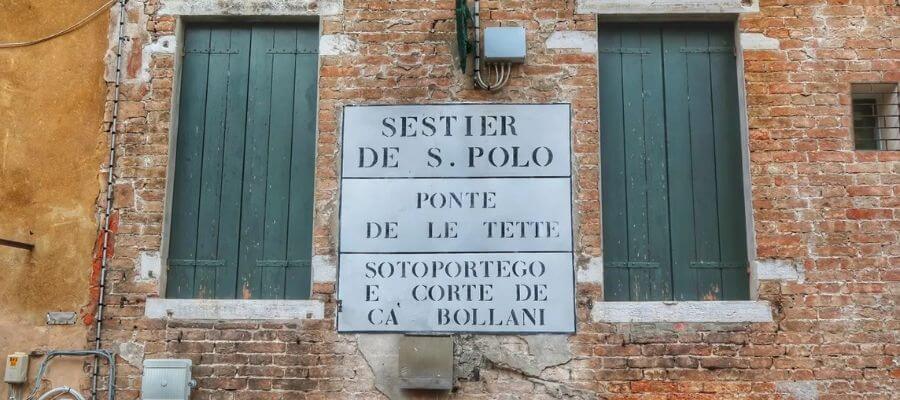
Venice it world-famous and unique throughout history, its millennia-old vicissitudes and adventures, and its unique toponymy. In this timeless city, toponymy , or the study of place names, is much more than a formality: it is a poetic map that guides us through centuries of daily life, trades, crafts, and legends.
As you stroll through the streets of this splendid city, you've surely wondered where the names you find written on the streets come from. Their originality is due to two elements: on the one hand, names like campo (field), piscina (pool), and so on recall the city's primary characteristic: marshland. On the other hand, Venice's toponymy draws inspiration from the daily lives of its inhabitants, the goods sold, and the foreign civilizations that have passed through these canals over the years.
By reading the niziolieti , or street signs painted on buildings, it's possible not only to learn the names of the streets, but also to retrace the history of Venice. The names have remained the same as they were centuries ago, and the calli, sestieri, and bridges are still indicated today by these white signs with black lettering, another wonderfully original feature of Venice.
Let's take a trip to Venice together to discover its toponymy, an alternative way to see the city and get to know it better.
Because a trip, even if it's a quick getaway or a simple weekend getaway, is nothing more than one discovery after another, and a city like Venice still hides so many surprises.
Why do we say Calle, Sestieri and Salizada?
Perhaps the most famous term in Venice, calle , obviously refers to the city's streets. In Venice there is only one street, the Strada Nova , which runs through Cannaregio. A calle is therefore a street, but narrower, sometimes as wide as a single person. Among the most curious are undoubtedly Calle Varisco , the narrowest in Venice, and Calle larga dei proverbi , so called because proverbs were once written on the houses here. If you're looking for a calle lined with shops, then you're looking for a Ruga.
The Saziada , or "paved" street, is a paved and often wider street, while the Ramo is a deviation from a larger calle, a small segment of road. If you come across a Campo, however, then you should know that you are in a small square and that these were once cultivated fields.
A different story, however, concerns the waterways lined with sidewalks, called Fondamenta . The Fondamenta della Riva degli Schiavoni is the widest and most important. As you may have understood by now, this language isn't just evocative: it's functional, accurately describing the city's living geography. Walking in Venice means learning a new urban idiom.
The sestieri of Venice and the layout of the city
The districts of Venice are called Sestieri di Venezia, a name that simply derives from the fact that there are six in total : the city has maintained the same medieval division. Dividing the city into two ideally different halves is the Grand Canal, which therefore separates the sestieri de citra from the sestieri de ultra.
The sestieri de citra are:
- Cannaregio;
- St. Mark;
- Castle.
Here too, the names are absolutely evocative. Cannaregio is so-called for the presence of numerous reed beds, San Marco takes its name from the eponymous square, while Castello still bears the memory of a small military garrison that no longer exists. The sestieri de citra occupy the western part of Venice, which is undoubtedly the largest.
The ultra districts are:
- Cross;
- St. Paul;
- Dorsoduro.
Dorsoduro districts take their names from the Church of Santa Croce , the Church of San Paolo , and the texture of the soil , which is particularly hard in the southern part of the city. The island of Giudecca is also part of Dorsoduro.
Venice: a city that speaks… Venetian
Language is another form of landscape. In Venice, not only is the toponymy unique, but also the way it is experienced. Saying " see you in the campo " has nothing to do with a game: the Venetian "campo" is the square , often with a church in the center and a wellhead. It is the social heart of the sestiere.
Venetians have shaped the names and jealously guarded them, resisting standardization. A street can be called Del Paradiso, Dei Boteri (the coopers), Del Magazen (the warehouse). Each name is a clue , a piece of the urban mosaic that fits together with history, geography, and popular culture.
Venetian toponymy is rich in references to its daily life, and in fact there are many references to trades, such as the calle dei fabbri (blacksmiths' street), dei potenti (powers' street), dei calafati (caulkers' street), degli avvocato (lawyers' street), etc. Venice has been and still is a cosmopolitan, rich, and dynamic city, and has managed to maintain its identity over the centuries.
Enrich your trip with the secrets of Venetian toponymy
Walking through Venice without knowing its secret names is like reading a novel while skipping chapters. The city's beauty lies not only in the reflections on the canals, the crooked bridges, or the still waters: it's in the names that evoke eras, lost crafts, love stories, and distant trades.
And if you book one of our vacation homes , perhaps in Calle del Forno or Corte dei Preti, those names will accompany you throughout your journey. They become part of your experience, like a poetic compass that guides your steps.

