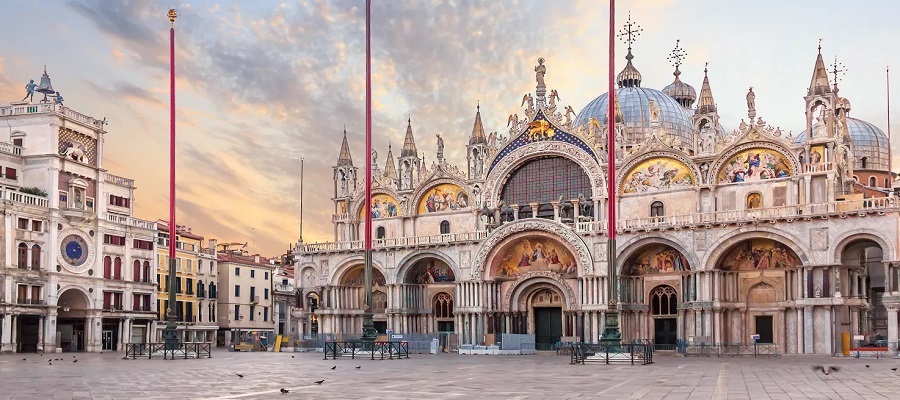
St. Mark's Basilica , one of Venice's architectural jewels, holds a rich history of adventure, sacredness, and intrigue. Located in St. Mark's Square, next to the majestic Doge's Palace , this basilica is not only a place of worship, but a symbol of the power and wealth of the Most Serene Republic of Venice .
The history of St. Mark's Basilica
The history of St. Mark's Basilica dates back to the year 828 , when Venetian merchants committed a daring act by smuggling the relics of St. Mark from distant Alexandria, Egypt, to protect the city and consolidate their religious identity. Legend has it that the merchants hid the precious relics inside a barrel of pork fat, a cunning move that passed inspection, given the abhorrence of pork in Arab culture.
Construction of St. Mark's Basilica dates back to 828, when the building was conceived as an extension of the Doge's Palace . The original basilica suffered a tragic fate in 928, when it was burned down during a revolt against Doge Pietro Candiano IV. However, this tragedy marked the beginning of a new era for the basilica. Construction of the current basilica began in 1063, the project aimed to celebrate the prestige and prosperity of the Venetian Republic.
Byzantine architecture became the backdrop for a unique synthesis of Eastern and Western influences. The five large domes, the Greek cross plan, and the use of precious materials from the East all gave the basilica an unparalleled majesty. Thus, the current structure of St. Mark's Basilica was consecrated in 1701 and has graced St. Mark's Square .
Highlights of St. Mark's Basilica
When planning a visit to St. Mark's Basilica, it's important to know the highlights to look out for. The interior of St. Mark's Basilica is a riot of light and color, thanks to the magnificent mosaics adorning its walls and domes. With over 8,000 square meters of mosaics , the golden details shine with a magical light, creating an atmosphere of sacredness and beauty. The interior architecture, with its Greek cross layout and imposing domes, captures the imagination of visitors, transporting them to a world of wonder and enchantment.
One of the basilica's most precious jewels is the Pala d'Oro , a peerless work of art. This Byzantine altarpiece, encrusted with hundreds of gems, including pearls, emeralds, sapphires, and rubies, is a testament to the mastery of the goldsmiths of Venice and Constantinople. It has been protected by protective glass since Napoleon stole some of its gems in 1797.
It's important to pay attention to the basilica's marbles . After the Fourth Crusade in 1204, Venice was enriched with precious marbles from Constantinople. These marbles, used in the basilica's construction, lend a touch of majesty and splendor to the structure. From the red porphyry associated with imperial power to the pavonazzetto used for the apse columns, each marble tells a story of grandeur and magnificence.
Continuing your exploration of the Basilica of Venice, you cannot miss:
- The Tomb of Saint Mark : located beneath the basilica's presbytery, the saint's relics rest here. Recently the subject of controversy, with some theories suggesting the bones of Alexander the Great are present, the tomb continues to be a place of devotion and veneration.
- The Basilica's Treasury : composed of over 283 pieces of gold, silver, and other precious materials, it is a priceless treasure trove of art and history. Divided into four sections, it includes ancient objects, Byzantine goldsmith works, and Islamic art.
Some important information for visiting St. Mark's Basilica
Here's some useful information for a stress-free visit to the Basilica:
- The basilica is open to visitors from 9:30 am to 5:15 pm daily; on Sundays and holidays, it is open to visitors from 2:00 pm to 5:15 pm.
- The basilica's bell tower is accessible every day from 9:30 am to 9:15 pm.
- Entrance to the Basilica is free, and can be accessed through the Porta dei Fiori entrance and from Piazzetta dei Leoncini. Prayers begin at 8:00 a.m. and end at 7:30 p.m. daily.
- Both ticket offices close thirty minutes early.
Finally, you can purchase a ticket with a free audio guide that allows you to skip the line up to 10 minutes before entry.
St. Mark's Basilica: A Jewel in Venice's Crown
St. Mark's Basilica is just one of the jewels in the crown of beautiful Venice, which, sestiere by sestiere, countless things to discover. To visit the Jewish ghetto or lose yourself in the city's canals, one day isn't enough; you'll need to book at least one night's stay. To save money, you can take advantage of the many benefits offered by the Venezia Card and enjoy the convenience of booking a private apartment online .

