The city of Padua preserves a Gothic heritage inextricably intertwined with its university and spiritual soul. Here, palaces, churches, and chapels are living pages of medieval history. Gothic, in fact, is not just stone and arches, but a constant dialogue between light, faith, and knowledge, inviting a slow stroll through the streets of a modern city where, simply by looking up, you can see elegant triple lancet windows and luminous rose windows.
Choosing to spend a weekend in Padua is never a given: visiting the Scrovegni Chapel and strolling through Piazza Prato della Valle isn't enough. To truly explore Padua and its Gothic legacy, it's important to take your time, walk and discover, and explore the city. This way, transforming a simple stay into an authentic and in-depth experience, where you can explore treasures throughout the day before returning to a warm, independent, and private apartment in the evening.
Why the Gothic style in Padua still enchants today
Padua has long been a crossroads of merchants, scholars, and pilgrims, especially in its golden age, the 14th century. During this period, it welcomed Gothic influences from Northern Europe, Venice, and France, adapting them to its practical and devout spirit, creating a unique blend: Paduan Gothic.
This style, with its pointed arches and stained glass windows that filter the light like prayers, blends here with Romanesque and Byzantine elements, creating a unique Venetian Gothic: less slender than French cathedrals, but rich in intimate and luminous details. Padua's Gothic is a hybrid, an adaptation of the austerity of French Gothic and the decorative richness of Byzantine-Venetian architecture. It doesn't push itself to excessive excess, but rather appropriates this art in a completely unique, more functional way. Padua has shaped a practical and inclusive Gothic
Scrovegni Chapel: Giotto's Gothic triple-lancet window
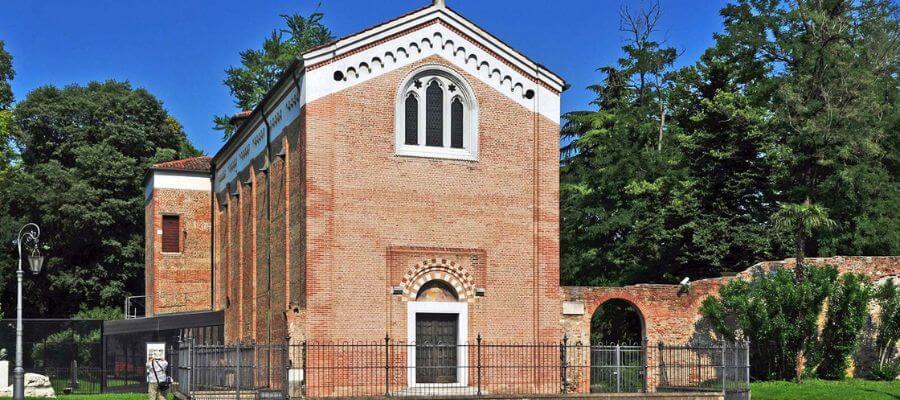
The Scrovegni Chapel is Padua's quintessential Gothic jewel, with its simple exposed brick façade and elegant Gothic triple lancet window that illuminates the interior.
Built between 1303 and 1305 by Enrico Scrovegni to atone for the sins of his usurer father mentioned by Dante, it features a rectangular hall with a barrel vault and tall, narrow single-lancet windows on the south wall, which capture the light to enhance Giotto's frescoes.
It's not just architecture: it's a container for the pictorial cycle on Salvation, from the Last Judgement to Vices and Virtues, a UNESCO World Heritage Site since 2021.Here, Giotto accomplished a true revolution in the representation of space. Within frescoes such as the cycle of the Stories of the Life of the Virgin and Christ, one can admire perspectives and the rendering of the third dimension that anticipated Renaissance theories by a hundred years.
Spatial studies are essential to refocus attention on humanity, its physicality and emotional sphere: Giotto depicted scenes rich in pathos, where both human joy and pain emerge with intensity. The frescoes of Giotto and his fourteenth-century school are a clear demonstration that architectural study and research are a functional element in the representation of emotion and humanity.
Basilica of St. Anthony: Venetian Gothic and devotion
The Basilica del Santo or also Basilica of Sant'Antonio, is a Romanesque-Gothic masterpiece begun immediately after the saint's death in 1231, with extensions that introduced Venetian Gothic elements such as slender bell towers and Moorish arches.
The Gothic façade, built in the 15th century with pointed arches and a raised tympanum, hides a three-nave interior with high domes and a quadrangular ambulatory with nine radial chapels, a rarity inspired by French Gothic.
Here, light and space blend in frescoed chapels and Baroque reliquaries housing works by Donatello, such as the high altar with its 30 bronzes. Also noteworthy are the works of Michele Sanmicheli and the monument to Cardinal Pietro Bembo and the monument to the Venetian nobleman Alessandro Contarini. The Basilica's cloisters offer a rare, silent and contemplative refuge, while the Antoniana Library on the upper floors houses more than 85,000 volumes, including medieval manuscripts.
Palazzo della Ragione: the hall suspended among the stars
The Palazzo della Ragione , or formerly Salone, was the civic heart of the fourteenth century. It housed the city's courts and epitomizes Paduan secular Gothic architecture with its great hanging hall, one of the largest in Europe, 81 meters long and covered by seven ribbed vaults interwoven in star-shaped patterns, like a stone firmament. The grandeur of the hall is a feature that even captivated Goethe when he visited Padua.
The walls adorn 14th-century astrological frescoes, with the signs of the zodiac and planetary influences that reflect the university knowledge of the time: here, the Gothic style not only elevates the spirit, but celebrates human reason, symbolizing communal power amid Gothic arches and loggias opening onto the Prato della Valle. It is an engineering masterpiece that defies gravity without excess, perfect for a sunset visit when the light filters through the triple-lancet windows, tinging the ribs blue.
Inside, the market is housed beneath the main hall, not a place for shopping, but a meeting point and obligatory passage.
Baptistery and other scattered Gothic signs
The Baptistery of the Cathedraladds to the Gothic tour of Padua a cycle of frescoes on ribbed cross vaults, illuminated by single-lancet windows that create depth effects on biblical scenes. Elsewhere, such as in the Church of the Eremitani or in the university buildings, hanging arches and openwork rose windows punctuate the urban fabric, making Padua a Gothic palimpsest to be discovered on foot.
The Gothic style in Padua is not merely an architectural feature, but a bridge between heaven and earth, between wisdom and spirituality, reflecting the essence of the city: a crossroads of enlightened souls, where the university's scientific research intertwines with popular devotion and cosmopolitan commerce. The pointed arches and ribbed vaults symbolize human inspiration, yet always anchored in a human and everyday dimension, true and authentic. Art and faith dialogue, anticipating the Renaissance with realistic perspectives and emotional frescoes, a quest for truth, to give substance to human sentiments.
Visiting these sites means immersing yourself in an era when Padua was a beacon of knowledge, a UNESCO legacy that today invites slow contemplation, rediscovering ourselves among its living stones.
Visit Padua for its Gothic architecture and more
You can come to Padua for the Gothic simply because here you don't visit isolated monuments, but an urban ecosystem where looking up reveals triple lancet windows in a crowded café or Moorish arches during an evening stroll: it's a continuous dialogue with the past that merges with modern vitality.
From your independent apartment in the center, you can transform your visit into an authentic journey: a morning at the Scrovegni Chapel with light shining on the frescoes, an afternoon at the Palazzo della Ragione among zodiac frescoes and lively markets, and finally, a contemplative evening in the cloisters of the Santo.
But Padua is more: explore Prato della Valle, Italy's oldest university with its Anatomical Theatre, or the Euganean Hills for a spa excursion—you choose what to see. Choose a short-term rental for a more personal and authentic pace, and experience a city that blends mystical Gothic with authentic flavors. For a stay that's not just a vacation, a deep immersion in a heritage that inspires and revitalizes: book your apartment now.

