
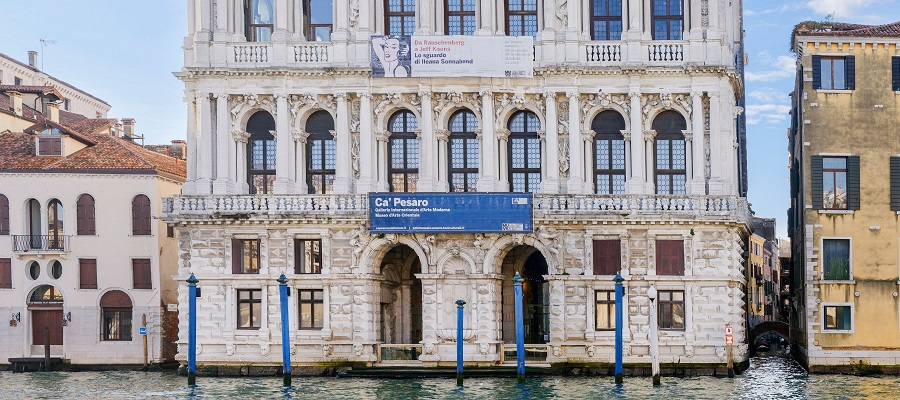
Ca' Pesaro is itself a majestic and beautiful palace, located on the banks of the Grand Canal in Venice and one of the most important examples of Baroque architecture in the Veneto.
Here's everything you need to know for those planning a vacation in Venice and wanting to discover the mysteries of the Gallery of Modern Art and the Museum of Oriental Art founded by the Bourbon dynasty.
The history of the Palace
The palace was commissioned by the noble Pesaro family and designed by the renowned architect Baldassarre Longhena, also known for works such as the Church of the Salute and Ca' Rezzonico. Construction of the palace began in 1659 with the creation of the courtyard featuring its original loggias. Although work progressed rapidly, the project was not completed until 1710, after Longhena's death, by Gian Antonio Gaspari , who substantially respected the original design.
The imposing palace itself is a good reason to plan a visit. To do so, we recommend using the official website for all the information on temporary exhibitions, opening times, and to buy tickets online.
The International Gallery of Modern Art
The Venice Gallery of Modern Art has constantly evolving permanent collections, enriched by new critical insights and innovative perspectives that constantly interact with the temporary exhibitions hosted in the rooms on the second floor.
For all enthusiasts, it is truly a spectacular place, home to iconic works such as Auguste Rodin's " The Thinker " and Gustav Klimt's " Judith II (Salomé) ." The collection also includes works by major artists such as Medardo Rosso, Giacomo Balla, Adolfo Wildt, Arturo Martini, Gino Rossi, Giorgio Morandi, and Felice Casorati.
Temporary exhibitions and new features at Ca' Pesaro
The museum of modern art is constantly evolving, in fact, in 2017 it saw the important arrival of the Chiara and Francesco Carraro Collection, while in February 2019, the collection was further enriched by a deposit of thirty-two works by some of the most important Italian authors of the twentieth century, including Massimo Campigli, Carlo Carrà, Giacomo Manzù, Ottone Rosai, Scipione and Mario Sironi.
Instead, the second main floor of the building is dedicated to rotating temporary exhibitions, which always offer new experiences and artistic visions to visitors, creating a dynamic and stimulating environment.
The Museum of Oriental Art
The third floor of the palace houses the permanent Museum of Oriental Art, a must-see for all enthusiasts. This collection is so important because it was built primarily on acquisitions made by Henry of Bourbon during his trip to the East between 1887 and 1889.
After various vicissitudes, the collection was acquired by the Italian state as reparations for war damages and, between 1925 and 1928, Nino Barbantini placed it on the top floor of Ca' Pesaro, thus creating the first state Museum of Oriental Art.
The Japanese collection
The Museum of Oriental Art is divided into several thematic sections. The seven rooms dedicated to Japan display a vast array of objects that narrate the life and culture of the Edo Period (1603-1868). Among the pieces on display are ceremonial weapons and armor belonging to feudal lords, lacquered saddles and stirrups, a rare lady's sedan chair, paintings on paper and silk, and silk dresses with rich embroidery.
The exhibition features gilded objects from the wedding trousseaus of aristocratic families, as well as highly prized musical instruments used for traditional Japanese music. There are also older works, such as wooden statues from the Kamakura period (1185–1333) and blades from the Muromachi period (1392–1568).
The Chinese and Southeast Asian Collection
The Chinese section includes jade and porcelain from various manufacturers, as well as a precious painted scroll. The Southeast Asian room features Thai silver and porcelain, Burmese lacquerware, rare kris, batik fabrics, and leather puppets from wayang, the traditional Indonesian shadow theater.
Some of the collection's works are displayed on rotation, while others, such as woodcuts, Buddhist altars, Chinese and Japanese robes and paintings, are placed in storage for conservation and space reasons.
Ca' Pesaro: Let's take stock
This beautiful palace and the collections hidden within it deserve an in-depth visit and offer a unique cultural and artistic experience in the heart of Venice.
To discover all the city's other beauties, a single day isn't enough, so it's a good idea to book an apartment online easily to save on your budget. To optimize your expenses, in addition to short-term rentals, we also recommend the Venezia Card for the discounts it offers.

