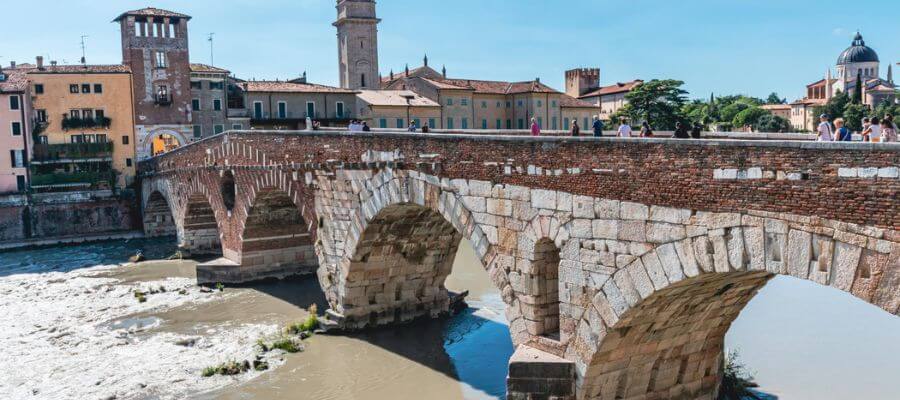
With the Adige River winding its way through the city, bridges are the only way to connect the city's different neighborhoods, but they are also speaking monuments that tell the story and characteristics of each individual site in Verona . Verona's bridges recount two thousand years of history : from the Romans to the Scaligeri, from the Serenissima to the wounds of the Second World War, up to the urban reconstructions of the twentieth century.
Walking along the river means crossing not only from one bank to the other, but from one era to another, crossing bridges that connect neighborhoods, memories, and different perspectives on the city. Perhaps you've already stayed in Verona and visited its most famous monuments, walked its narrow streets, and crossed its bridges, but perhaps you haven't stopped to reflect on their shape, history, and development. So here's an ideal itinerary among Verona's bridges , to discover the city from a different perspective.
The Roman: Ponte Pietra
We couldn't begin our ideal journey through Verona's bridges without the oldest: the Ponte Pietra . It is the only Roman bridge still standing in the city, built over a ford used since prehistoric times between the hill of San Pietro and the plain. It dates back to the 1st century BC , making it one of the first major works built by the Romans upon their arrival, designed to connect the city center to the hill and the roads leading to the Adige Valley and the north.
Its structure is characterised by the combined use of white stone blocks, for the parts of Roman origin, and bricks, for the arches rebuilt in later periods, with the typical donkey-back shape of Roman bridges.
Having survived numerous floods of the Adige River, it was blown up by the retreating Germans in 1945 during World War II and rebuilt after the war using anastylosis, reassembling stones recovered from the riverbed. It is 90 meters long and about 7 meters wide, its five arches lead to the historic center, the Cathedral, and the Roman Theater, up to the hill of San Pietro and the residential neighborhood that rises towards Castel San Pietro , one of the most beautiful panoramic points in Verona, perfect for a romantic sunset over the city .
It's a bridge worth seeing because it represents the most authentic memory of Roman Verona and offers a suggestive view of houses, bell towers, and hills: perfect at sunset or in combination with a visit to the Roman Theater and the funicular.
The medieval: Castelvecchio Bridge
Also known as the Scaligero Bridge , it is one of the absolute symbols of medieval Verona, a bold and admirable work built between 1354 and 1356 under the rule of Cangrande II della Scala, and therefore in connection with the Castelvecchio fortress of which it was an integral part.
Its original purpose was strategic: to ensure the fortress had a quick escape route north toward Tyrol in the event of internal uprisings or attacks, taking advantage of its position where the river is particularly wide and difficult to ford. The bridge is easily recognizable by its massive crenellated walls, three large brick and stone arches , and the slope that slopes toward the opposite bank, all details that create a scenic route suspended over the Adige.
Like other bridges in Verona, it was destroyed by the Germans in 1945 and faithfully rebuilt in the 1950s, recovering the collapsed sections from the riverbed. It connects the historic center with the Borgo Trento neighborhood on the right bank , although today its primary function is pedestrian and touristic. It's worth seeing because it offers one of the most scenic walks in the city, with views of the Arena , the walls, and the bell towers, and is perfect for including in an itinerary that combines the Castelvecchio Museum, the city walls, and the Lungadige promenade.
Ponte Garibaldi: between the historic center and Borgo Trento
On the northern side of the historic center is Ponte Garibaldi, which connects the Duomo and Via Garibaldi area with Borgo Trento , the residential neighborhood on the opposite bank. It is an old, modern iron bridge built in the 19th century to a design by English engineer Alfred Henry Newille, with a three-span structure supported by stiles driven into the riverbed, 75 meters long and nearly 9 meters wide. It was later replaced by a masonry bridge better suited to the traffic needs of the Adige River, its flooding, and the evolution of the neighborhood. It features four stone sculptures by artist Ruperto Banterle, including Garibaldi.
Ponte Garibaldi was also destroyed in 1945 during the German bombings that struck almost all the city's bridges. It was rebuilt after the war with a reinforced concrete structure clad in stone, in keeping with the architectural style of the time. It effectively connects the historic heart , with the Duomo and the medieval streets, to Borgo Trento and the residential neighborhoods to the northwest, and represents an important axis between the old city and the modern areas.
The Garibaldi Bridge offers an excellent view of Ponte Pietra to the east and Castel San Pietro, allowing you to take some truly evocative photographs of Verona's urban landscape. It's often used as a crossing point for those who, after visiting the Duomo, want to reach Borgo Trento or the scenic routes in the hills north of the city.
The twentieth century: the Victory Bridge
A bridge between historical memory and urban function, built to celebrate the Italian victory in the First World War . Designed by architect Ettore Fagiuoli and built between 1926 and 1929, it was inaugurated on November 4th, a symbolic date linked to the end of the conflict and the Battle of Vittorio Veneto.
The bridge originally featured a strong celebratory display, with four bronze sculptural groups representing Victory and decorative elements that emphasized the commemorative nature of the work. Like other city bridges, it was mined by the Germans in 1945 and, after the war, was rebuilt by simplifying the structure, removing some panoramic terraces and reducing some of the original decoration.
Ponte della Vittoria connects the Old Town and the central area with the Borgo Trento neighborhood and the so-called Campagnola area , strengthening connections between the historic heart and the residential areas north of the river. Today it is an important roadway, but it also remains an admirable bridge for understanding the monumental language of the interwar period and for the views of the bend in the Adige, the Arena, and the historic facades along the river.
Ships Bridge
This bridge stands on a site where a Roman crossing already existed, but the current structure has medieval origins. Built of stone in 1373 at the behest of Cansignorio della Scala, to replace an earlier bridge, it owes its name to the fact that boats sailing up the river docked in this stretch of the Adige , constituting an important commercial hub.
on Ponte delle Navi : the final battle between Cangrande II della Scala and his brother Fregnano took place here during an internal rebellion. After quelling the insurrection, Cangrande had Fregnano thrown into the river, where he drowned. Following this event, a church dedicated to Santa Maria della Vittoria was built nearby as a vow of charity.
Over the centuries, the bridge suffered damage from flooding by the Adige River and, in the 19th century, was replaced first by an iron structure and then by a marble bridge. This too was destroyed in the Second World War and rebuilt after the war. It connects the historic center in the area of Via Leoni and Porta Leoni with the neighborhoods on the left bank to the southeast , along the axis leading to Borgo Roma, and remains significant for understanding the city's relationship with the river as a trade and transportation route.
Verona's Bridges: A Slow Journey Along the Adige River
Bridges are an engineering and technical challenge due to environmental difficulties caused by the presence of water, functional and material requirements, etc. In addition to the more famous ones, structures such as Ponte Catena , Ponte Unità d'Italia , and Ponte San Francesco are modern constructions, strengthened to withstand floods and floods, and today they punctuate the urban profile along the Adige and "serve" thousands of people every day.
There are itineraries dedicated to Verona's bridges , spanning over 7 km across key points of the city . This physical and imaginary journey takes you across Verona's bridges, alternating between glimpses of the historic center, 20th-century neighborhoods, and views of the hills. This historical journey enters and recounts the city's urban fabric, offering an alternative way to grasp the profound meaning of these structures: not just infrastructure, but lines that unite eras, functions, memories, and different ways of experiencing the city.
Next time you visit Verona, stay in one of the historic neighborhoods and walk along and across the Adige River with new eyes, pausing to admire how human intervention has made a city on the river habitable since Roman times. Stay in the historic center or explore short-term rentals in neighborhoods like Borgo Trento, Veronetta , or Cittadella for a more in-depth exploration of the city's architectural makeup.
What are you waiting for? Book one of our apartments .

