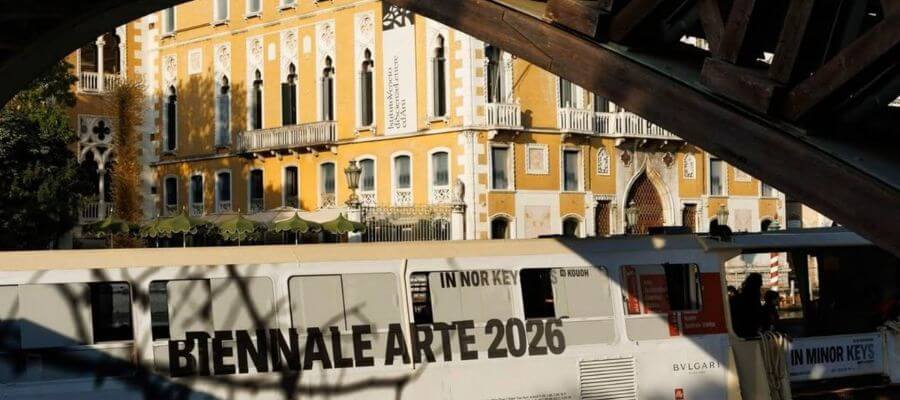
If you think you're visiting the 2026 Venice Art Biennale simply by attending an exhibition, you're sadly mistaken. The Biennale is an event that expands and extends throughout the city, reverberating through the squares, alleys, and streets of Venice. The 61st edition, curated by Koyo Kouoh, is full of interesting yet powerful themes, dedicated to those who know how to listen and perceive thought beyond the contemporary noise.
This Art Biennale unfolds between the Giardini and the Arsenale, but its performances extend far beyond the main routes: you can find scattered events inside pavilions scattered throughout the city, unlikely locations where you'll find the most interesting performances. And don't think you'll need one day to see it all: you have time from May 9th to November 22nd, 2026 , but to truly experience it, you'll have to experience it, perhaps for more than just one day.
A visit to the Art Biennale is also a great excuse to visit Venice and see it with a different perspective; the same places will never seem the same again: the Biennale is for those who travel slowly, those who take the time to reflect and explore, those who leave nothing to chance. The 2026 Art Biennale is for you, those who know how to be surprised. Here, then, are some helpful tips to help you plan your visit.
When, where and at what time: what to know about the 2026 Art Biennale
The Venice Biennale Arte is a contemporary art exhibition that has existed since 1895 and is presented every two years with a different curator and a different exhibition. This year's exhibition is curated by Cameroonian Koyo Kouoh, the first African woman to hold this position, but who passed away last year. Her idea was then carried forward by her team in her name. The exhibition features 111 artists, including collectives, duos, individual artists, and organizations from diverse backgrounds.
The international exhibition titled In Minor Keys will be held primarily at the two historic venues of the Giardini and the Arsenale, along with Forte Marghera in Mestre, flanked by dozens of pavilions spread across Venice's districts. A total of 31 collateral events will be held in palaces, churches, and other spaces throughout the city. If you're planning a visit to the Biennale, keep in mind that it is closed on Mondays, with the exception of a few special openings scheduled for May 11, June 1, September 7, and November 16.
The exhibition's motifs are linked to the theme of Processions seen as performances and collective movement; thus, Altars have been placed, dedicated to artists of the past in homage to them, while the Schools are spaces dedicated to learning and sharing, independent of market rules. Knowing these motifs or key words will help you navigate the exhibition with greater awareness.
During the summer season, until September 27th, the spaces are open from 11:00 am to 7:00 pm. If you prefer a late afternoon atmosphere, the Arsenale extends its opening hours until 8:00 pm on Fridays and Saturdays. Starting September 29th, the autumn hours will take effect, with entry brought forward to 10:00 am and closing at 6:00 pm. Knowing the opening hours will help you plan your visit, but be aware that inside the exhibition spaces, and even outside, you'll end up forgetting the clock. Along the way, you'll find installations designed like Oasis or Rest, places where you can slow down, pause to reflect, contemplate, and admire, where the noise of modern life fades away and you can let your thoughts wander.
Helpful tips for a stress-free visit
After checking out the program and choosing your must-see events, remember that the best way to optimize your visit is to purchase tickets online on the official website. Also remember that you cannot purchase them on-site.
A full ticket costs 30 euros, but if you'd like to approach the exhibitions in a more thoughtful way, there are advantageous multiple-entry passes valid for 3 or 7 consecutive days. This will allow you to absorb the details of the works while spreading out your visits without anxiety.
You can reach the Arsenale from the station on ACTV lines 1 and 4.1, or from Punta Sabbioni on the ACTV line to San Zaccaria and then change to lines 1 or 4.1. If you're coming from Marco Polo Airport, take the Alilaguna Blu line, the same one that takes you to the Giardini. Find the timetables here.
Also remember that the best approach is not to try to see the Gardens and the Arsenale at the same time, as the distances and the amount of visual stimulation require time and energy. Ideally, you should dedicate a morning or a full day to the Gardens to enjoy the best light and fewer crowds, and reserve another day or evening for the Arsenale.
Grouping side events by district will help you reduce vaporetto trips, transforming your day into a pleasant Venetian stroll, best undertaken with comfortable shoes. Let yourself go!
May to June is definitely one of the best times to visit the Art Biennale: the exhibitions have just opened, the air is still spring-like, and there aren't many crowds. September is also an ideal month to visit the Biennale, with its milder temperatures and the chance of encountering fewer tourists.
The real secret to a stress-free visit? Sleeping in Venice
Visiting the Biennale should be a feast for the eyes and the soul, not a marathon against the clock. The best way to de-stress and fully embrace the philosophy of slow travel is to choose to stay right in the city's historic center. Renting a self-contained apartment, equipped with all the necessary amenities, frees you from the rigid train and ferry schedules, avoiding the classic, chaotic evening rush to the mainland.
Imagine ending your day immersed in art by returning to a welcoming, quiet home, where you can make yourself a coffee in your private kitchen before heading out to enjoy the empty streets of the evening. By choosing an apartment in Venice, you can find the ideal solution for experiencing the city on your terms: with ample space, a personalized pace, and the complete freedom to transform your visit to the Art Biennale into a true vacation of reflection and contemplation.

