The 2026 Art Biennale is not a static event, frozen in time; it is a movement, an opportunity to reflect, to ponder current life and its meanings, modern hypocrisies in relation to the past, and an interesting way to build a new future.
But the Biennale, as we have seen, is also a new way to explore the city of Venice, to discover how a single city can be an international sounding board with its artistic exploration of cultures from around the world.
The 2026 Venice Art Biennale continues and will continue to offer us breathtaking surprises throughout the city. And if there's one place that deserves a special place on your itinerary this year, it's undoubtedly Palazzo Manfrin, home to the exhibition organized by the Anish Kapoor Foundation, one of the most intense stops in Venice during the Biennale. Located in the Cannaregio neighborhood, this historic building has been restored to its former glory and opens its doors with a breathtaking contemporary art exhibition.
Discovering this and other wonders of the 2026 Art Biennale is a unique opportunity, and this year there are many new features and opportunities to reflect on society and ourselves. If you're planning your visit to the Biennale, the best way to enjoy this experience is certainly with a short stay in the city: choose your apartment in the center or in a quieter area, and get around easily on foot or by public transport. Between vaporettos and narrow streets, you can discover the authentic life of Venice even in summer and admire the masterpieces of contemporary art without a care in the world.
A glorious past re-emerged from oblivion
The history of Palazzo Manfrin is a fascinating tale in itself, one of opulence and inevitable decadence. In the 18th century, under the leadership of Count Girolamo Manfrin, the building became one of Europe's most vibrant cultural centers. It housed an art collection so prestigious that it attracted illustrious visitors such as Lord Byron and Antonio Canova, enchanted by the masterpieces that adorned its walls. Yet, that golden age was followed by a long and inexorable decline, leaving the grand halls empty and abandoned to the relentless humidity of the lagoon.
Today, thanks to its acquisition and the meticulous restoration commissioned by the Anish Kapoor Foundation, the building has been given a new lease of life. The architects courageously chose not to erase the signs of time, avoiding artificial restoration.
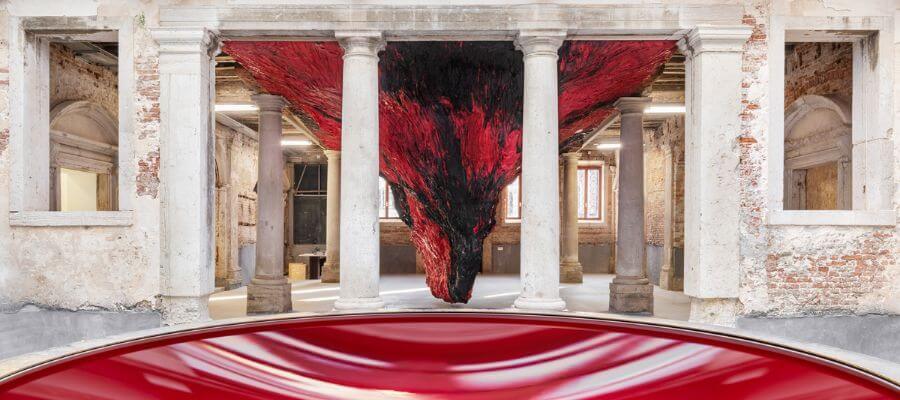
Instead, they left the exposed brickwork, imperfect stucco, and peeling frescoes to act as a spectacular theatrical backdrop, creating a formidable balance between the fragility of the old and the solidity of the new.
The palace itself is therefore a constant dialogue between decadence and modernity, a concept excellently amplified by the exhibition it hosts.
Anish Kapoor's material vertigo
Entering Palazzo Manfrin today means accepting a sense of disorientation. Kapoor's monumental works occupy the spacious halls, engaging in a stark and poetic dialogue with the ancient Venetian architecture, a contrast that captivates the eye and the palate.
On one side, we find visceral installations in blood-red wax that seem to pulsate with a life of their own, evoking the energy and perishability of the material. On the other, we lose ourselves before the artist's famous voids: chasms of such a deep and absolute black that they obliterate the perception of three-dimensionality, defying our minds and the laws of physics.
This constant tension between the decadent delicacy of the location and the conceptual brutality of the sculptures perfectly complements the atmosphere of this year's edition. In total, there are 100 architectural models spanning 50 years of work, including ideas, sketches, models, and sculptures, including designs for the monumental Cloud Gate in Chicago and projects never realized. Kapoor is not just a sculptor: his work straddles the boundaries between sculpture, architecture, and perception. For the artist, material becomes a mental experience, not just a physical one: his works don't simply occupy a space, they alter it, deform it, and render it unstable.
Anish Kapoor is renowned for his exploration of black, which obliterates all references. At Palazzo Manfrin, this exploration emerges even more forcefully because the works are not isolated, but inserted into a context that amplifies their perceptive power. The stainless steel surfaces, pigment, concrete, silicone, paint, and especially Vantablack, a material capable of absorbing all visible light, construct a path where the material is never simply matter, but a form of language. Kapoor works as if each substance had its own psyche: metal reflects and destabilizes, deep black engulfs, wax and silicone evoke the body, blood, and the fragility of flesh.
The heart of the exhibition lies in the one hundred architectural models documenting over fifty years of research, including both completed projects and those left in the study stage. This shifts the artist's image from that of large-scale sculptures to that of an experimenter and creator of nearly impossible intuitions.
The projects on display include completed works such as ArcelorMittal Orbit, the observatory tower in London; Ark Nova, the inflatable concert hall developed with Arata Isozaki; and the Monte Sant'Angelo metro station in Naples, inaugurated in 2025. All these models are not displayed with the austerity typical of museums, but are fragments of a moving thought, mental landscapes, often fragile, that convey an idea of space as something yet to be constructed, to be rewritten, in a constant vertigo that challenges all our certainties.
Venice as a new experience
Venice becomes, if that's possible, even more splendid during the Biennale. But the crowds aren't lacking: during the Biennale, it can become exhausting if you don't plan your stay well. That's why choosing accommodation in the city center, preferably convenient for major transport links, allows you to better enjoy exhibitions like the one at Palazzo Manfrin and plan a smoother itinerary between the Giardini, the Arsenale, and related venues.
Sleeping in Venice also means truly immersing yourself in the city's rhythm: leaving early in the morning, wandering through still-quiet streets, stopping for a break between visits, and returning stress-free after a day full of excitement and inspiration.
During the Biennale, this aspect becomes an integral part of the cultural experience. Palazzo Manfrin tells three stories at once: that of Venice in its golden years, that of architecture reopening and re-examining itself, and that of Kapoor, who has always straddled the boundary between sculpture and habitable space. The exhibition is worth a visit because it focuses not only on spectacle, but on the depth of the creative process, bringing together models, materials, installations, and ideas in a setting seemingly tailor-made to accommodate them.
It's a stop that appeals to both contemporary art lovers and those seeking a Biennale opportunity to understand Venice from a different, more intimate, and less predictable perspective. The exhibition will be open from May 6th to August 8th, 2026: if you don't want to miss it, book your stay in Venice now.

